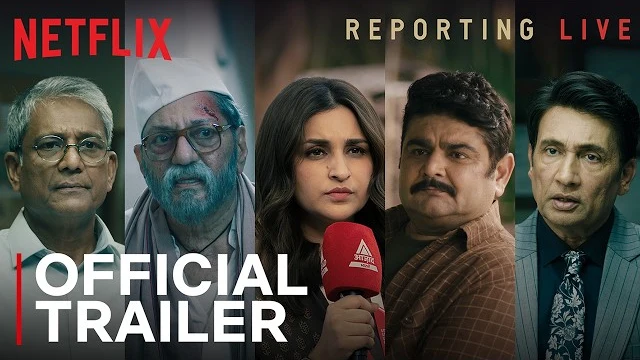
- Reporting Live movie review verdict: a relevant investigative premise held back by a weak script.
- The Sunday Guardian scored it 2.5/5, citing a worthwhile subject but uneven execution.
- Parineeti Chopra leads as the journalist driving the illegal sand-mining investigation.
- Released October 9, 2026 on Netflix with Hindi audio and multilingual subtitles.
- Best for: viewers who prefer issue-driven journalism dramas over fast-paced action thrillers.
Reporting Live Movie Review: The Short Verdict
Reporting Live arrived on Netflix on October 9, 2026 as a Hindi-language investigative thriller, and critics have responded with a consistently mixed message: the story matters, but the telling rarely matches it. Our Reporting Live movie review weighs the film's real strengths, including a committed lead performance and a socially urgent premise, against the pacing and screenplay problems that most reviewers flagged.
Video Highlights (from the official trailer):
- The on-the-ground reporting setup between journalist and photographer
- Escalating threats tied to the illegal sand-mining network
- A newsroom-versus-local-power conflict framed in moody, nocturnal visuals
The film follows a journalist and a photographer whose coverage of a bridge accident pulls them into a wider investigation involving illegal sand mining, institutional pressure, and the personal risks of publishing uncomfortable truths.
Pick Reporting Live if you enjoy issue-driven dramas in the vein of Indian investigative thrillers. Skip it if you expect sustained action set pieces, several critics note the excitement level stays modest throughout.
Critic Ratings and Review Scores
The professional response has been respectful but reserved. The clearest published score comes from The Sunday Guardian, while Hindustan Times and Film Information offered qualitative assessments without numerical ratings.
| Outlet | Focus | Verdict Summary | Rating |
|---|---|---|---|
| The Sunday Guardian | Premise, script | Worthwhile subject, weak script, mixed overall | 2.5/5 |
| Hindustan Times | Story, excitement | A story to tell but little excitement to offer | No score stated |
| Film Information | Direction, performances | Weighs whether the premise becomes a compelling thriller | No score stated |
| Audience score | General reception | Not consolidated in published references | N/A |
Audience scores and user reviews were not consolidated in the available critical references as of October 2026. Treat the table above as a media-response snapshot rather than a full reception picture.
Strongest Element
- Relevant social premise
- Illegal sand mining rarely gets screen time
- Grounded journalistic stakes
Weakest Element
- Screenplay inconsistencies
- Uneven dramatic escalation
- Underdeveloped secondary arcs
Divisive Element
- Pacing and excitement
- Critics split on thriller payoff
- Slow-burn over spectacle
Performances and Cast Assessment
Parineeti Chopra anchors the film as the lead journalist whose investigation moves from a bridge-accident story to a broader public-interest exposé. Reviewers consistently treated her performance as the film's most reliable asset, even when criticizing the material around her.
| Cast Member | Role in the Film | Review Consensus |
|---|---|---|
| Parineeti Chopra | Lead journalist | Carries the investigative line with conviction |
| Deven Bhojani | Core supporting role | Part of the principal cast around the investigation |
| Amol Palekar | Principal cast | Adds weight to the institutional side of the story |
| Supporting ensemble | Photographer, newsroom, network figures | Functional, with limited development noted |
Chopra's role is a journalism-led part rather than a conventional action heroine. Expect interviews, evidence gathering, and moral pressure rather than combat-driven sequences.
Story Strengths and Weaknesses: What Works, What Doesn't
To evaluate the film fairly, break the viewing experience into its narrative stages and assess each against what an investigative thriller needs to deliver.
The Hook: The Bridge Accident
The opening incident works as a clean entry point. A bridge collapse demands explanation, and the reporters' arrival establishes stakes quickly. Most reviewers found this the film's most efficient stretch.
The Investigation: Evidence Gathering
Documents, testimony, and field reporting expand the story toward illegal sand mining. This is where the script shines thematically but slows dramatically, the segment critics most often called underpowered.
The Escalation: Confronting Power
The journalists collide with interests that benefit from silence. The conflict is real, but reviewers noted the thriller mechanics stay restrained, limiting tension.
The Resolution: The Cost of Truth
The ending emphasizes that publishing is only one part of accountability. Thematically satisfying, dramatically understated, a fair summary of the whole film.
| Story Element | Grade | Why |
|---|---|---|
| Premise and subject | ★★★★☆ | Illegal sand mining is urgent and rarely filmed |
| Lead performance | ★★★★☆ | Chopra sustains the investigative line |
| Screenplay | ★★☆☆☆ | Weak dialogue structure, per The Sunday Guardian |
| Pacing and thrills | ★★☆☆☆ | Little excitement, per Hindustan Times |
| Ending and meaning | ★★★☆☆ | Thoughtful but low-impact resolution |
Reporting Live works best as a social-issues drama wearing thriller clothes. Judge it on its journalism and themes, and it rewards the viewing; judge it purely as a suspense machine, and it falls short.
Themes: Why the Story Matters
The film's critical defenders point to its themes as the reason it deserves attention despite the script problems.
Journalism Under Pressure
- Editors, access, and intimidation shape the story
- Publishing carries personal risk
- Truth-seeking versus institutional self-protection
Illegal Sand Mining
- Environmental and infrastructure harm
- Ties to local power networks
- Weak enforcement enables continuation
The film keeps these as fictional dramatic devices rather than documentary claims, but the underlying issues are real and well documented across India, which is precisely why critics praised the choice of subject even while faulting the execution.
Reporting Live is a fictional narrative informed by real social issues. It is not a dramatization of one specific documented case.
Should You Watch It? Checklist and FAQ
Use this checklist to decide whether Reporting Live fits your taste before pressing play on Netflix.
Watch Reporting Live If You Want:
- A socially grounded Hindi investigative drama
- Parineeti Chopra in a serious, journalism-led role
- Themes of media pressure and public accountability
- A slow-burn story over action spectacle
Q: Is Reporting Live worth watching based on the movie review consensus?
It depends on your taste. The Reporting Live movie review consensus praises the subject and Parineeti Chopra's performance but criticizes the script and low excitement level. A 2.5/5 from The Sunday Guardian suggests a middle-of-the-road experience, best for fans of issue-driven thrillers.
Q: What is the critic rating for Reporting Live?
The Sunday Guardian gave the film 2.5/5. Hindustan Times and Film Information published qualitative reviews without numerical scores, describing a film with an important story but limited thrills.
Q: Where can I watch Reporting Live?
The film streams exclusively on Netflix, released October 9, 2026, with Hindi original audio and subtitle options including English that vary by region.
Q: Is Reporting Live based on a true story?
No. The film is a fictional investigative thriller, though its central issue, illegal sand mining and its ties to local power, reflects real and widely reported social concerns in India.